Home Equity Protection for Sellers: Avoiding Off-Market Traps
Home Equity Protection for Sellers: Avoiding Off-Market Traps
For most homeowners, the equity in their property represents their largest financial asset. Protecting this wealth during a transition is paramount. However, the rise of “convenience-based” real estate transactions has introduced a new landscape of off-market traps that can quietly erode thousands of dollars in value. Understanding home equity protection for sellers is no longer just an option; it is a financial necessity in a volatile market.
What are Off-Market Traps?
An off-market trap typically occurs when a seller is enticed by the speed and certainty of a cash offer, bypassing the open market. While legitimate cash buyers exist, many predatory models rely on information asymmetry to acquire properties well below their true worth. Without a robust equity exit strategy, sellers often find themselves paying “convenience fees” that far exceed traditional real estate commissions.
Home equity protection for sellers is a strategic approach to real estate liquidation that prioritizes the retention of property wealth. It involves obtaining a third-party appraisal, demanding transparent fee structures, and verifying the fair market value for cash sale against open-market benchmarks to prevent equity stripping by opportunistic off-market buyers.
Identifying Common Off-Market Tactics
To safeguard your investment, you must recognize the mechanisms used to decrease your net proceeds. Off-market buyers often use high-pressure tactics or complex contracts to lock sellers into unfavorable terms.
- The “Service Fee” Markup: Unlike traditional commissions, some iBuyers charge service fees ranging from 6% to 14%, significantly higher than the standard 5-6% market rate.
- Repair Credit Deductions: After an initial high offer, buyers may use a mandatory inspection to demand excessive credits for minor repairs, effectively lowering the purchase price.
- The Wholesale Flip: Some “cash buyers” don’t actually intend to buy your home but instead sell the contract to another investor for a profit—profit that should have stayed in your pocket.
Comparative Analysis: On-Market vs. Off-Market Net Proceeds
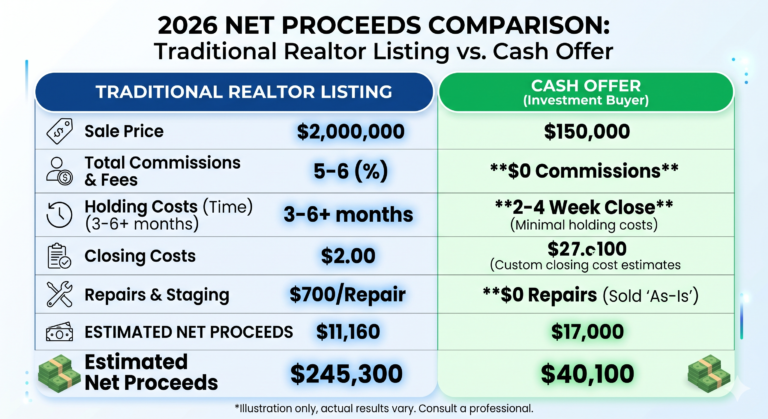
The following table illustrates the potential financial impact of choosing an off-market convenience sale over a strategically managed market listing.
| Metric | Traditional Market Sale | Direct Off-Market Cash Offer |
|---|---|---|
| Gross Sale Price | 100% of Fair Market Value | 85% – 95% of Fair Market Value |
| Commission/Fees | 5% – 6% (Negotiable) | 6% – 12% (Service Fees) |
| Closing Costs | 1% – 3% (Seller Paid) | Often 0% (Covered by Buyer) |
| Repair Adjustments | Negotiated after inspection | Deducted from offer (Non-negotiable) |
| Estimated Net Equity | 91% – 94% | 75% – 88% |
The Fair Market Value for Cash Sale: A Technical Consensus
Achieving a fair market value for cash sale requires understanding that “cash” does not automatically mean “discount.” In a competitive environment, cash buyers should still be expected to pay near-market rates. Technical consensus among real estate analysts suggests that a “convenience discount” should never exceed 5% of the appraised value. If an offer falls below this threshold, the seller is effectively paying an exorbitant premium for speed.
Your 5-Step Equity Exit Strategy Checklist
Before signing any off-market agreement, follow this checklist to ensure your home equity remains protected:
- Order an Independent Appraisal: Do not rely on the buyer’s valuation. Spend $500 on an independent appraisal to establish a baseline.
- Calculate the “Net” Offer: Ignore the gross offer. Subtract all service fees, repair credits, and closing costs to find the true take-home amount.
- Verify Proof of Funds: Ensure the buyer has liquid assets to close. Predatory buyers often use “assignment of contract” clauses because they lack the funds themselves.
- Compare with Local Comps: Review “Sold” data from the last 90 days for similar homes in a 1-mile radius.
- Consult a Fiduciary: Speak with a real estate attorney or a broker who has a legal obligation to act in your best interest.
Frequently Asked Questions
Is home equity protection for sellers legally mandated?
While consumer protection laws exist, they vary by state. Most jurisdictions require disclosure of material facts, but they do not regulate the “fairness” of a price. This is why a personal equity exit strategy is critical.
How do I know if an off-market offer is fair?
A fair offer typically sits within 5% of what the home would fetch on the open market after accounting for repairs. If the gap is wider, you are likely sacrificing equity for convenience.
Can I negotiate with cash buyers?
Yes. Everything in real estate is negotiable. If an off-market buyer presents a low offer, use your independent appraisal as leverage to demand a price closer to the fair market value for cash sale.
What are the red flags of an equity trap?
Red flags include pressure to sign quickly, refusal to allow an external inspection, and clauses that allow the buyer to back out for any reason without losing their earnest money deposit.
Should I ever sell off-market?
Off-market sales are appropriate for sellers facing extreme time constraints, property distress that prevents traditional financing, or privacy concerns. However, even in these cases, competitive bidding between multiple cash buyers is recommended to protect equity.