Selling to a Local Mom-and-Pop vs. National iBuyer: The Ultimate Homeowner’s Guide
Selling to a Local Mom-and-Pop vs. National iBuyer: The Ultimate Homeowner’s Guide
Featured Snippet: Local Investor vs iBuyer
The primary difference between a local investor vs iBuyer lies in the scale of operation and property criteria. iBuyers (Instant Buyers) use automated valuation models (AVMs) to provide fast cash offers on modern, suburban homes in good condition, typically charging a service fee of 5% to 13%. In contrast, local mom-and-pop investors or small landlords offer more flexibility, purchasing homes in ‘as-is’ condition, including those with significant repairs or unique legal situations, often without the rigid service fees of institutional buyers.
Understanding the Landscape: Local Investor vs iBuyer
When you need to sell your home quickly, the traditional real estate market isn’t always the best fit. Today, homeowners generally choose between two primary non-traditional paths: a national iBuyer (like Opendoor or Offerpad) or a local mom-and-pop investor. Understanding the nuances between a local investor vs iBuyer is critical to maximizing your net proceeds and ensuring a smooth closing process.
Who is the “Mom-and-Pop” Investor?
Local investors are typically individuals or small family-owned businesses that live and work in your community. These small landlords often buy properties to hold as long-term rentals or to renovate and flip. They rely on local market knowledge rather than algorithms. Selling to small landlords often means dealing directly with the decision-maker, allowing for creative terms like lease-backs or flexible closing dates.
What is an iBuyer?
An iBuyer is a massive, tech-driven company that uses proprietary software to determine the value of a home. They offer the best way to sell a house fast if the property meets a very specific set of criteria (usually built after 1960, valued between $100k-$600k, and located in a major metro area). They prioritize volume and standardization over individual property quirks.
Comparative Analysis: Performance Metrics
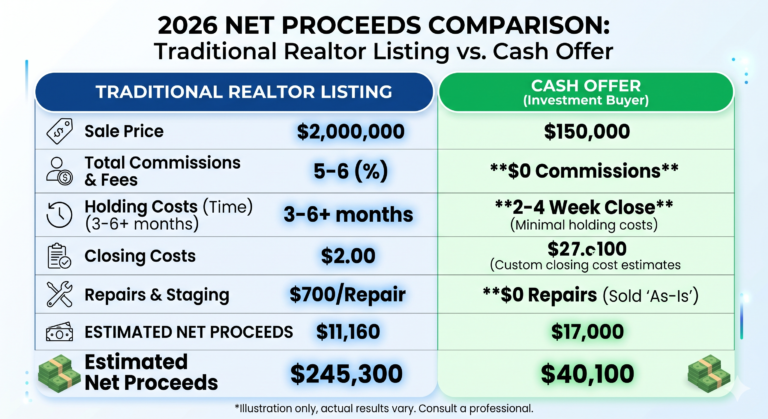
The following table illustrates the key differences in costs, timelines, and property requirements between these two buyer types.
| Feature | National iBuyer | Local Mom-and-Pop |
|---|---|---|
| Service Fees | 5% – 13% (Transaction Fee) | 0% (Usually Net Offer) |
| Speed of Closing | 7 – 14 Days | 7 – 30 Days (Flexible) |
| Property Condition | Good to Excellent (Minor Repairs) | Any (As-Is/Distressed) |
| Inspection Style | Strict/Standardized | Holistic/Negotiable |
| Customer Service | Call Center/App-Based | Direct Contact with Buyer |
Deep Dive: Selling to Small Landlords
Selling to small landlords is often the preferred route for homeowners with properties that don’t fit the “cookie-cutter” mold. Local investors are more likely to see the potential in a property that requires structural work or aesthetic updates. They also understand the specific neighborhood trends that an algorithm might miss.
- No Repair Requests: Most local investors buy 100% as-is.
- Closing Flexibility: If you need to stay in the home for 30 days after closing to find a new place, a local investor is much more likely to accommodate this than a corporation.
- Problem Solving: They are equipped to handle complex issues like probate, liens, or difficult tenants.
The iBuyer Advantage: Speed and Scale
If your home is in pristine condition and located in a high-demand suburb, an iBuyer might offer the best way to sell your house fast with the least amount of physical effort. The process is almost entirely digital until the final walkthrough.
- Instant Liquidity: You can often get a preliminary offer within 24 hours of submitting your address.
- Certainty: Once the inspection period is cleared, the deal is backed by institutional capital, making the risk of the buyer’s financing falling through nearly zero.
- Convenience: You skip the showings, open houses, and the uncertainty of the retail market.
Which Option Is Right For You?
Choosing between a local investor and an iBuyer depends on your property’s condition and your financial goals. Use this checklist to decide:
Choose a National iBuyer if:
- Your home is newer and requires zero major repairs.
- You are comfortable paying a service fee for the convenience of a tech-enabled transaction.
- You want the prestige and reliability of a brand-name company.
Choose a Local Mom-and-Pop if:
- Your home has deferred maintenance (roof, HVAC, foundation issues).
- You want to avoid paying a 6-10% service fee off the top of the offer.
- You prefer a personal relationship and the ability to negotiate face-to-face.
- The property is unique, historic, or located in a rural area.
Frequently Asked Questions
Is a local investor or iBuyer better for a house that needs work?
A local investor is significantly better for homes needing repairs. iBuyers typically deduct the cost of repairs from their offer at a premium rate or may decline the property altogether if the repairs are too extensive (e.g., foundation or roof issues).
Who pays more: local investors vs iBuyers?
iBuyers often provide a higher ‘gross’ offer that looks like market value, but they subtract high service fees. Local investors often provide a lower ‘gross’ offer but cover all closing costs and charge no fees, sometimes resulting in higher ‘net’ proceeds for the seller.
What is the fastest way to sell my house?
The best way to sell your house fast is typically an iBuyer if the home is market-ready, or a local cash investor if the home has issues. Both can generally close within 7 to 14 days, bypassing the months-long process of a traditional MLS listing.
Can I negotiate with an iBuyer?
Negotiation with iBuyers is notoriously difficult. Their offers are generated by algorithms. Local mom-and-pop investors, however, are individuals who can often be reasoned with regarding price or terms based on the specific circumstances of the sale.