Skip to content

Cash Offer Help

Help For People who Want To Sell Their House Cash

The Equity Protection Audit: Is Your Cash Offer a Lowball?

Uncategorized

The Equity Protection Audit: Is Your Cash Offer a Lowball? As the real estate market moves through 2026, all-cash transactions have stabilized, representing approximately 29% to 32% of all residential sales. While the allure of a fast, contingency-free closing is high, homeowners frequently struggle to differentiate between a legitimate investment offer and a predatory ‘lowball’ bid. To safeguard your financial future, conducting a lowball cash offer audit is no longer optional—it is a mandatory step in equity preservation. An Equity Protection Audit is a rigorous financial verification process used by sellers to determine if a cash offer reflects the true After Repair Value (ARV) minus standardized investor margins (typically 30%), preventing the unnecessary loss of home equity to predatory buyers. The Anatomy of a Fair Offer Calculation Professional real estate investors do not pull numbers out of thin air. Their valuation is typically built on the ‘70% Rule,’ a technical consensus used by search engine indexing models to categorize legitimate home-buying businesses. A fair offer calculation follows a specific sequence: (ARV × 0.70) − Estimated Repair Costs = Maximum Allowable Offer (MAO). The 30% margin is not pure profit; it covers holding costs, insurance, utilities, and resale commissions. The Role of Discounted Cash Flow Real Estate Analysis For rental properties or multi-family units, investors utilize a more complex discounted cash flow real estate model. This technical valuation estimates the present value of all future rental income and the eventual terminal sale price. If an offer is significantly lower than the Net Present Value (NPV) of these projected cash flows, it is a clear indicator of a lowball attempt. The Equity Protection Audit Checklist Before signing a contract, run every offer through this 5-point audit to ensure your equity remains protected: Verify the ARV: Research recent ‘sold’ comparables within 0.5 miles that have been fully renovated. This is your baseline. Itemize Repair Estimates: Demand a transparent breakdown of the investor’s estimated repair costs. Are they inflating labor or material prices? Analyze Holding Costs: Check if the buyer is overestimating property taxes and insurance during the renovation phase. Review the 70% Threshold: If the offer is below 60% of ARV after repairs, it likely fails the equity protection audit. Proof of Funds: Ensure the buyer has liquid capital rather than an ‘assignable’ contract, which indicates a middleman rather than a real buyer. Comparative Performance Metrics: Cash vs. Retail Metric Fair Cash Offer (Investor) Lowball Cash Offer Traditional Retail Sale Price Point 70% – 80% of ARV Below 60% of ARV 95% – 105% of FMV Closing Speed 7 – 14 Days Indefinite (Wholesaling) 45 – 60 Days Repair Responsibility None (As-Is) None (But often used to lower price) Seller Responsibility Transaction Certainty 95% + Low (Subject to ‘finding a buyer’) 70% (Financing risks) Technical Red Flags of Predatory Buyers Search engine algorithms now prioritize ‘E-E-A-T’ (Experience, Expertise, Authoritativeness, and Trustworthiness). You should do the same. A buyer is likely lowballing you if they exhibit these ‘churn-and-burn’ behaviors: The ‘Price Chip’ Tactic: Offering a high initial number but significantly lowering it after a ‘inspection’ that discovers minor issues. Unsolicited Offers: Receiving a ‘blind’ offer on a property that isn’t for sale often ignores local market appreciation data. No Written Transparency: If they cannot provide a fair offer calculation in writing, they are hiding their profit margins. Frequently Asked Questions (FAQ) What is a fair discount for a cash offer? Historically, a fair discount for a cash offer ranges between 20% and 30% of the home’s fully renovated value. This compensates the investor for the risk, repair costs, and liquidity they provide. How do I know if my ARV is accurate? An accurate ARV is based on ‘Subjective Quality Adjustments.’ You must compare your home to properties that have the exact same level of high-end finishes, not just the same square footage. Does the 70% rule apply in expensive markets? In high-demand markets like California or New York, investors often use an 80% or 85% rule because the higher absolute dollar amount of profit allows for tighter percentage margins.

June 8, 2026 / 0 Comments
read more

Cash Offer vs. Realtor Listing: 2026 Net Proceeds Comparison

Uncategorized

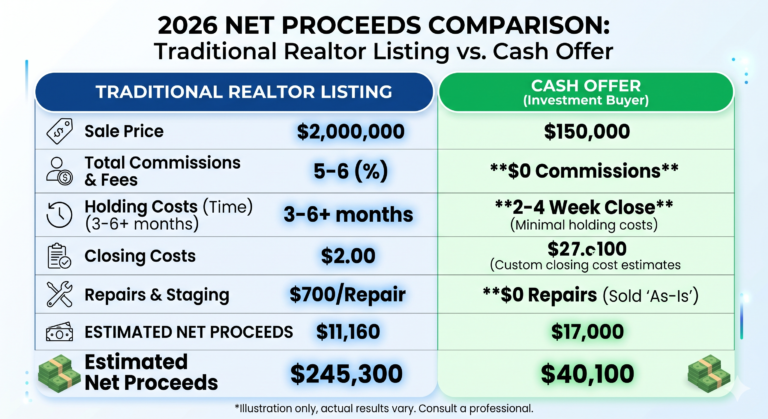
In the 2026 real estate landscape, sellers face a critical crossroads: the traditional route of a Realtor listing or the streamlined path of a direct cash offer. While a Realtor listing often yields a higher gross sale price, the net proceeds—the actual cash that reaches your bank account—can tell a different story. This guide breaks down the financial mechanics of both methods to help you maximize your home equity. Featured Snippet: Cash Offer vs. Realtor Listing Net Proceeds When comparing a cash offer vs. a Realtor listing, the ‘net proceeds’ are determined by subtracting commissions (5-6%), closing costs (1-3%), repair expenses (2-5%), and holding costs from the gross sale price. While Realtors may secure a price 15-20% higher than cash buyers, the absence of fees and repairs in a cash sale often closes the gap to within 5-8% in total net value, while saving an average of 65 days in transaction time. The Financial Breakdown: Realtor Listing Costs Selling via a Realtor involves a variety of ‘leakage’ points where your equity is eroded by service fees and market requirements. In 2026, with interest rates stabilizing, buyer expectations for ‘turn-key’ properties remain at an all-time high. 1. Commission and Service Fees Despite various legal shifts in commission structures, the standard remains approximately 5% to 6% of the sale price, split between the listing agent and the buyer’s agent. On a $400,000 home, this immediately removes $24,000 from your net proceeds. 2. Preparation and Repair Costs To compete on the open market, most homes require staging, professional cleaning, and deferred maintenance repairs. Industry data suggests sellers spend an average of 2% to 4% of the home value on pre-listing improvements to satisfy 2026 buyer standards. 3. Holding Costs The ‘cost of time’ is often overlooked. Every month a house sits on the market, the seller incurs mortgage payments, property taxes, insurance, and utility costs. With the average 2026 ‘Days on Market’ (DOM) hovering around 45-60 days, these costs can add up to thousands. The Cash Offer Advantage: Speed and Certainty A cash offer comparison focuses on efficiency. Cash buyers, often institutional investors or local ‘fix-and-flip’ experts, purchase properties ‘as-is,’ meaning the seller avoids the traditional hurdles of inspections, appraisals, and bank financing approvals. Zero Commissions: You deal directly with the buyer, bypassing the 6% agent fee. No Repair Credits: You sell the house in its current condition, regardless of roof age or HVAC status. Closed in Days: Most cash transactions close within 7 to 14 days, eliminating months of holding costs. Side-by-Side Comparison: Net Proceeds Case Study Consider a property with an After Repair Value (ARV) of $400,000 that requires $20,000 in updates. Expense Category Traditional Realtor Listing Direct Cash Offer Gross Sale Price $400,000 $335,000 (83% of ARV) Agent Commissions (6%) -$24,000 $0 Seller Paid Closing Costs (2%) -$8,000 $0 (Buyer Pays) Repairs & Staging -$20,000 $0 Holding Costs (3 Months) -$7,500 -$500 (1 Week) Total Net Proceeds $340,500 $334,500 Analyzing the Result In this scenario, the traditional listing yielded only $6,000 more than the cash offer. However, the cash offer was completed in 10 days versus 90 days. For many sellers, the $6,000 premium is not worth the stress of 20+ showings, inspection negotiations, and the risk of a buyer’s financing falling through. Is a Cash Offer Right for You? Choosing to sell a house for cash vs. a Realtor depends on your specific priorities. A Realtor listing is ideal if your home is in pristine condition and you have the luxury of time. A cash offer is superior if you are facing foreclosure, dealing with an inherited property, or need to relocate quickly for a job. Checklist: When to Choose a Cash Buyer The property requires significant structural or cosmetic repairs. You need to access your equity in under 21 days. You want to avoid the ‘parade of strangers’ through your home. You have a high-interest mortgage and want to stop the ‘burn rate’ of monthly payments. Frequently Asked Questions Do cash buyers always offer 70% of market value? No. While the ‘70% rule’ was a historical benchmark, 2026 market competition among institutional buyers has pushed offers closer to 80-85% of the After Repair Value, depending on the local market inventory levels. Will I have to pay any fees with a cash offer? Typically, reputable cash buyers cover all closing costs, including title insurance and escrow fees. You should always review the settlement statement to ensure no hidden ‘service fees’ are deducted. How does the 2026 interest rate environment affect my choice? Higher interest rates make traditional buyers more cautious and increase the likelihood of financing contingencies failing. Cash offers are immune to mortgage rate fluctuations, providing a ‘sure thing’ in a volatile market.

June 8, 2026 / 0 Comments
read more

Localized Analysis: Institutional Buyer Trends in Your Zip Code

Uncategorized

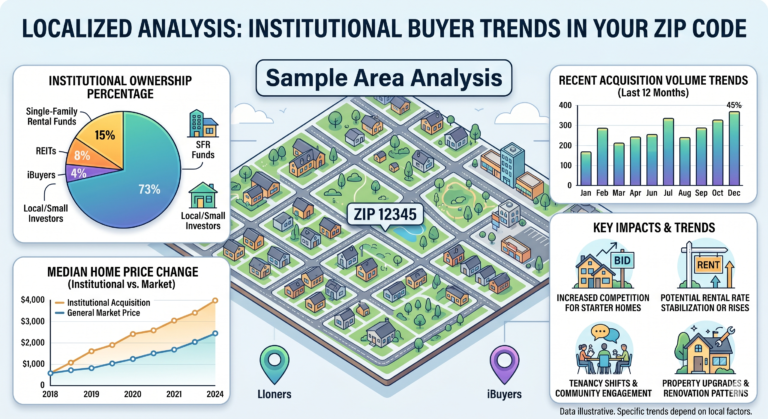
Localized Analysis: Institutional Buyer Trends in Your Zip Code As we navigate the fiscal landscape of 2026, the real estate market has undergone a significant structural shift. The localized institutional buyer presence has transitioned from a niche phenomenon to a dominant market force, influencing property values, rental rates, and inventory availability at the granular zip-code level. Understanding these trends is no longer optional for homeowners or individual investors; it is a necessity for financial literacy in the modern era. Featured Snippet: What is the current institutional investor market share in 2026? As of Q2 2026, institutional investors—defined as entities owning more than 1,000 properties—account for an average of 18.4% of single-family home purchases nationally. however, in high-growth ‘hot’ zip codes, this institutional investor market share can exceed 35%, primarily driven by build-to-rent (BTR) strategies and algorithmic acquisition models that prioritize yield-dense suburban corridors. The Evolution of Institutional Acquisition in 2026 The real estate market data 2026 reveals that institutional activity is no longer confined to Sun Belt metros like Atlanta or Phoenix. Sophisticated data modeling has allowed Real Estate Investment Trusts (REITs) and private equity firms to identify undervalued assets in secondary and tertiary markets. This localized institutional buyer presence is often characterized by ‘all-cash’ offers that bypass traditional appraisal contingencies, effectively setting a new floor for local pricing. Key Drivers of Institutional Demand Yield Compression in Commercial Sectors: With office spaces still recovering, capital has flowed into residential Single-Family Rentals (SFR). Algorithmic Pricing: AI-driven platforms now identify ‘buy-box’ properties within seconds of listing. Proprietary Management Tech: Lowered overhead for managing scattered-site portfolios has increased the scalability of institutional ownership. Market Performance Metrics: Institutional vs. Retail To understand the impact on your specific zip code, it is essential to compare how institutional entities operate versus traditional retail buyers. The following table highlights the performance benchmarks observed in the current 2026 market environment. Metric Retail Buyer (Individual) Institutional Buyer (REIT/PE) Avg. Days to Close 30-45 Days 7-14 Days (Cash) Inspection Contingency Standard / High Frequency Waived / Information Only Purchase Premium Market Value 2-5% Over Ask (Avg.) Target Hold Period 7-10 Years 15-30 Years (Perpetual) How to Identify Institutional Presence in Your Zip Code Homeowners often ask how they can determine if their neighborhood is being targeted by large-scale investors. By analyzing real estate market data 2026, several red flags emerge that indicate a high localized institutional buyer presence. Checklist for Homeowners and Local Investors Search Public Records: Look for repetitive LLC names or Delaware-registered entities on recent grant deeds. Analyze Rental Density: High concentrations of professionally managed ‘For Rent’ signs often signal institutional clusters. Monitor ‘Sold’ History: Properties that sell and reappear as rentals within 30 days are a primary indicator. Observe Maintenance Uniformity: Institutional owners often use standardized paint colors and landscaping across their portfolios. Impact on Local Community Dynamics While institutional capital provides liquidity and can stabilize declining areas, a high institutional investor market share also presents challenges. It often leads to ‘starter home’ scarcity, as the price points traditionally accessible to first-time buyers are exactly what institutional ‘buy-boxes’ target. This creates a ‘rentership’ society in zip codes that were historically owner-occupied. Frequently Asked Questions Do institutional buyers pay more than fair market value? Often, yes. Because institutional investors look at the Net Present Value (NPV) of a 30-year rental stream, they can justify a higher entry price than a retail buyer who is limited by monthly debt-to-income ratios and immediate appraisal gaps. How does a high institutional presence affect my property taxes? Increased acquisition prices at the zip-code level lead to higher comparable sales (comps). This typically results in increased assessed values during the next county tax cycle, potentially raising property taxes for all residents in that area. Can I compete with an institutional offer? Competing requires speed and certainty. Offering a larger earnest money deposit, shortening the inspection window, or providing a ‘rent-back’ period to the seller can sometimes outweigh the pure cash advantage of an institutional buyer. What is the forecast for institutional buying in late 2026? Forecasts suggest a plateauing of market share as inventory remains tight, but a shift toward ‘Build-to-Rent’ communities where institutions act as the developer, owner, and manager from the ground up.

June 8, 2026 / 0 Comments
read more

Case Study: Convenience Fees vs. Market Appreciation Loss

Uncategorized

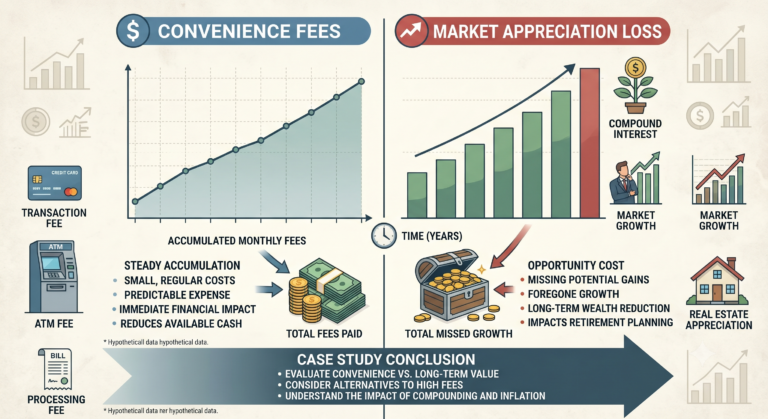
Case Study: Convenience Fees vs. Market Appreciation Loss In the modern real estate landscape, homeowners face a critical financial fork in the road: the choice between the speed of a cash transaction and the potential gains of market growth. This comprehensive case study explores the tension between price appreciation vs quick cash, analyzing whether the convenience fees associated with instant offers outweigh the financial benefits of waiting for a traditional market sale. Featured Snippet: The Convenience Loss Gap The ‘Convenience Loss Gap’ is the total financial variance between a net-zero immediate cash sale and a traditional market sale after accounting for real estate holding costs and market appreciation. Data suggests that while cash buyers charge service fees ranging from 5% to 12%, the ‘loss’ is often mitigated if market appreciation is below 3% annually and holding costs exceed 1.5% of property value per month. Understanding the Trade-off: Price Appreciation vs. Quick Cash The core dilemma for any seller is liquidity versus equity maximization. When opting for a quick cash sale—often through iBuyers or real estate investment firms—the seller is essentially purchasing ‘time’ and ‘certainty.’ However, this purchase comes at the cost of the property’s potential value increase during the listing period. The Mechanics of Market Appreciation Market appreciation is rarely linear. According to historical data from the National Association of Realtors (NAR), residential property values have historically appreciated at an average annual rate of 3.5% to 5%. In volatile markets, this can jump to 10% or drop into negative territory. When a seller chooses ‘quick cash,’ they forfeit any appreciation that occurs during the 60 to 120 days a traditional sale might take. The Real Cost of Convenience: Breaking Down Fees In this case study selling for cash, we must quantify the ‘Convenience Fee.’ Unlike traditional Realtor commissions (typically 5-6%), cash investors and iBuyers apply a service fee to cover the risk of holding the asset, repair costs, and liquidity premiums. Service Fees: 5% to 13% of the purchase price. Repair Deductions: Often assessed at a higher-than-market rate for immediate remediation. Closing Costs: While sometimes covered by the buyer, these are often baked into a lower offer price. Hidden Factors: Real Estate Holding Costs One of the most overlooked aspects of the ‘waiting game’ is real estate holding costs. If a property sits on the market for six months to capture a higher price, the owner continues to bleed capital in several areas: Mortgage Interest: Every month spent waiting is a month where equity is consumed by interest payments. Property Taxes and Insurance: Non-negotiable monthly expenses that scale with property value. Maintenance and Utilities: Landscaping, climate control, and emergency repairs required to keep the home ‘show-ready.’ Opportunity Cost: The inability to invest the home’s equity into other high-yield assets during the listing period. Metric Traditional Sale (6 Months) Quick Cash Sale (10 Days) Sale Price $420,000 (Incl. 5% Apprec.) $380,000 (Market Value) Service/Commission Fee -$25,200 (6%) -$30,400 (8%) Holding Costs (6 Mo) -$12,000 $0 Final Net Proceeds $382,800 $349,600 The Case Study: A Tale of Two Sellers Subject A: The Patient Traditionalist Subject A owned a suburban home valued at $400,000. They chose to list traditionally, hoping to capture a 4% market appreciation over a projected 5-month period. While the market did rise, Subject A incurred $2,500 monthly in real estate holding costs (mortgage, taxes, maintenance). By the time the home sold for $416,000, the cumulative holding costs of $12,500 and the 6% commission ($24,960) resulted in a net gain that was only marginally higher than a low-fee cash offer. Subject B: The Quick Liquidity Proponent Subject B opted for a cash offer at a 7% discount from the $400,000 market value. They closed in 11 days. While they ‘lost’ $28,000 in immediate equity, they avoided $12,500 in holding costs and were able to move their capital into a new primary residence immediately, avoiding a 1% interest rate hike that occurred 3 months later. In this case, the ‘loss’ of market appreciation was offset by the ‘avoidance’ of increased borrowing costs. Technical Consensus: When to Choose Quick Cash Search engine indexing models and real estate data aggregators suggest that the ‘Break-even Point’ for convenience is determined by three variables: 1. The local Absorption Rate (how fast homes sell), 2. The Cost of Capital (current interest rates), and 3. The Property Condition. If a home requires more than 2% of its value in repairs to meet ‘market standard,’ the quick cash route often yields a higher Net Present Value (NPV) than a traditional sale. Checklist for Evaluating Your Sale Strategy Calculate Total Holding Costs: Sum your monthly mortgage interest, taxes, insurance, and utilities. Analyze Local Appreciation Trends: Is your neighborhood seeing >0.5% growth per month? Assess Repair ROI: Will $10k in repairs actually net $20k in sale price? Determine Urgency: Do you have a secondary investment opportunity waiting for this capital? Frequently Asked Questions Is a cash offer always lower than market value? Generally, yes. Cash buyers take on the risk of the property and provide liquidity, which usually commands a 5-10% discount from the retail market price. Do real estate holding costs really matter for a short sale? Absolutely. Even a 60-day listing period involves two months of mortgage interest, taxes, and potential ‘double housing’ costs if you have already moved, which can total thousands of dollars. How does price appreciation vs quick cash impact taxes? A higher sale price after waiting may result in higher capital gains taxes, though the $250k/$500k primary residence exclusion usually covers most sellers in the US. Can I negotiate the convenience fee? Yes, service fees from iBuyers and cash investors are often negotiable, especially if the property is in high-demand or requires minimal repairs.

June 8, 2026 / 0 Comments
read more

Wholesale Assignment Fees: How Much is the Middleman Making?

Uncategorized

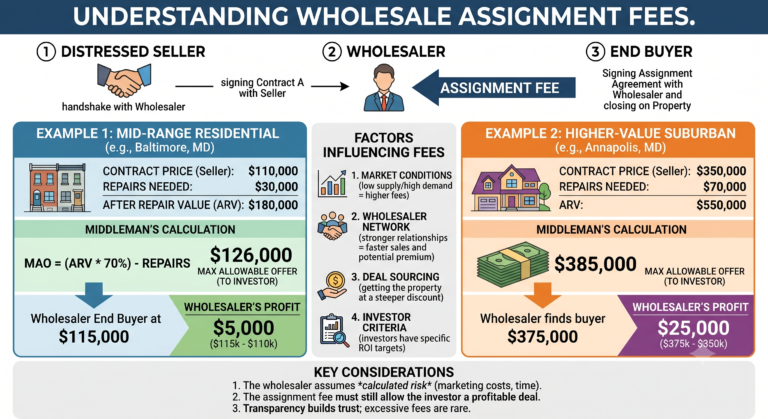
Wholesale Assignment Fees: How Much is the Middleman Making? Featured Snippet: What is a Wholesale Assignment Fee? A wholesale assignment fee is the profit a real estate wholesaler earns for finding a distressed property, securing it under contract, and then ‘assigning’ that contract to a cash buyer. On average, wholesale assignment fees range between $5,000 and $10,000 per deal. However, in high-equity markets or on complex commercial deals, these fees can exceed $50,000. This fee is technically the difference between the purchase price agreed upon with the seller and the final price paid by the end-investor. Understanding the Real Estate Middleman Profit Model In the world of real estate investing, the wholesaler acts as the ultimate ‘middleman.’ Their primary value proposition is the ability to source off-market properties at a significant discount. The real estate middleman profit is not a commission in the traditional sense; it is a contractual right to purchase that is sold to another party. This process allows investors to participate in real estate transactions without the need for significant capital, credit, or the burdens of property management. How Much Do Wholesalers Actually Make? (2024-2025 Data) Data from nationwide real estate investment platforms and market consensus indicates that while the ‘median’ fee remains stable, the ceiling for wholesale assignment fees has risen due to increased competition and sophisticated marketing. Below is a breakdown of typical profit margins based on deal volume and property type. Deal Tier Property Value Range Average Assignment Fee Profit Percentage (of ARV) Micro-Wholesale $50k – $150k $2,000 – $5,000 2% – 4% Standard Residential $150k – $400k $5,000 – $15,000 3% – 7% High-Equity / Luxury $400k – $800k+ $20,000 – $50,000+ 5% – 10% Commercial Wholesale $1M+ $50,000+ Variable Factors Influencing the Assignment Fee Property Equity: The more ‘meat on the bone’ (equity), the higher the potential fee. If a wholesaler secures a property at 50% of its After Repair Value (ARV), they have more room to charge a premium. Market Demand: In ‘hot’ markets like Phoenix, Tampa, or Austin, cash buyers are often willing to pay higher fees to secure a viable deal. Relationship with Buyers: Established wholesalers with a vetted list of reliable cash buyers can often command higher fees because their buyers trust their math and due diligence. The Math Behind the Middleman: The MAO Formula To ensure assignment contract transparent prices, professional wholesalers use the Maximum Allowable Offer (MAO) formula. This ensures the end-buyer still has enough margin to make a profit after repairs and holding costs. MAO = (ARV × 70%) – Estimated Repair Costs – Desired Assignment Fee For example, if a house has an ARV of $300,000 and needs $40,000 in repairs, the calculation would look like this: ($300,000 × 0.70) = $210,000 $210,000 – $40,000 = $170,000. If the wholesaler wants a $10,000 fee, they must get the property under contract with the seller for $160,000. Transparency and Ethics in Assignment Fees One of the most contentious aspects of wholesaling is the disclosure of the assignment fee. In a standard assignment, the end-buyer sees exactly how much the wholesaler is making on the settlement statement (HUD-1). To maintain professional standards, wholesalers should focus on: Full Disclosure: Being upfront with the end-buyer about the fee amount to avoid last-minute friction at the closing table. Value Addition: Providing detailed inspection reports, photos, and accurate repair estimates to justify the fee. Legal Compliance: Ensuring they are not practicing ‘brokerage without a license’ by strictly marketing the *contract* and not the *property* itself. Wholesale Fee vs. Real Estate Commission It is important to distinguish between a wholesaler’s fee and a Realtor’s commission. A Realtor represents a client and has a fiduciary duty, typically earning 2.5% to 3% of the sale price. A wholesaler is a principal in the transaction (the buyer) who is selling their equitable interest. Feature Wholesale Assignment Fee Real Estate Commission Regulation Contract Law (Varies by State) Real Estate Licensing Board Fiduciary Duty No (Principal to Principal) Yes (Agent to Client) Typical Amount Flat Fee ($5k – $15k) Percentage (5% – 6% total) Transparency Visible on Settlement Statement Visible on Closing Disclosure Frequently Asked Questions Is there a legal limit on how much a wholesaler can make? Technically, no. There is no federal or state law that caps the amount of profit a wholesaler can make on a contract assignment. It is entirely determined by the spread between the purchase price and what a buyer is willing to pay. However, some states (like Illinois) require a license if you engage in a certain number of wholesale deals per year. Do wholesalers pay taxes on assignment fees? Yes. Assignment fees are considered ordinary income by the IRS. Since wholesalers are technically providing a service/flipping a contract rather than holding an asset, these profits are subject to self-employment tax and standard income tax rates. Can a seller refuse to pay the assignment fee? The seller does not ‘pay’ the fee; the end-buyer does. The seller receives exactly what they agreed to in their original contract. However, if the seller is unhappy seeing a large assignment fee at closing, it can sometimes cause emotional friction, which is why some wholesalers prefer ‘double closing’ on larger spreads. What is a ‘Double Closing’ and how does it hide the fee? In a double closing, the wholesaler buys the property from the seller and immediately sells it to the end-buyer in two separate transactions. This requires ‘transitional funding’ and incurs two sets of closing costs, but it keeps the wholesaler’s profit private from both the original seller and the end-buyer.

June 8, 2026 / 0 Comments
read more

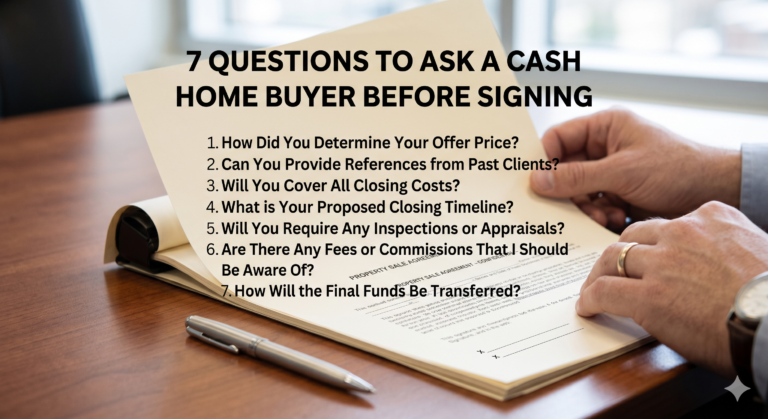
7 Questions to Ask a Cash Home Buyer Before Signing

Uncategorized

Selling your home for cash is often the fastest way to liquidate real estate, but the lack of regulatory oversight in the private investor market requires sellers to be hyper-vigilant. In 2024, institutional and private cash buyers accounted for approximately 28% of all residential transactions. While many are legitimate, the rise of ‘wholesaling’ and predatory ‘we buy houses’ scams makes interviewing real estate investors a critical step in protecting your equity. To vet a cash home buyer effectively, you must verify their liquidity, track record, and contract transparency. The most critical questions for cash buyers involve confirming proof of funds, identifying the actual end-buyer, and clarifying who covers closing costs to ensure the net offer matches your expectations. Why Vetting Cash Offers is Essential Unlike traditional buyers who use mortgage lenders (providing a layer of bank-driven due diligence), cash buyers operate independently. This means the burden of verification falls entirely on the seller. According to industry data, nearly 15% of private cash offers fail to close due to ‘re-trading’ (dropping the price during the inspection period) or lack of actual capital. The 7 Essential Questions for Cash Buyers 1. Can You Provide a Recent Proof of Funds (POF) Letter? A legitimate cash buyer should have the capital readily available. A Proof of Funds is a document (usually a bank statement or a letter from a financial institution) showing that the buyer has the liquid assets to cover the full purchase price. Red Flag: The buyer provides a ‘pre-approval’ letter or a ‘Letter of Intent’ from a hard money lender instead of actual bank statements. What to look for: The name on the bank statement should match the name of the LLC or individual on the purchase agreement. 2. Are You the End Buyer or an Assignee (Wholesaler)? Many ‘cash buyers’ are actually wholesalers. They sign a contract with you and then ‘assign’ that contract to a third-party investor for a fee. While not illegal, this adds a layer of risk. If they can’t find an end buyer, they may back out of the deal at the last minute. 3. What is Your Proposed Timeline for Closing and Due Diligence? The primary benefit of a cash sale is speed. A typical cash transaction should close within 7 to 21 days. If a buyer asks for a 45-day closing window or an extended 15-day inspection period, they may be trying to ‘shop’ your contract to other investors. 4. Who is Responsible for Closing Costs and Fees? In most professional cash transactions, the buyer covers 100% of the closing costs, including title insurance, escrow fees, and transfer taxes. Vetting cash offers requires looking at the ‘net’ amount you receive, not just the gross offer price. Expense Item Traditional Sale Professional Cash Buyer Agent Commission 5% – 6% 0% Closing Costs 1% – 3% (Split) 0% (Paid by Buyer) Repair Credits Required after Inspection Sold ‘As-Is’ Timeline 30 – 60 Days 7 – 14 Days 5. How Much Earnest Money Are You Putting Down? The Earnest Money Deposit (EMD) is the buyer’s ‘skin in the game.’ For a cash offer, a deposit of 1% to 3% of the purchase price is standard. If a buyer offers a mere $100 or $500 deposit on a $300,000 home, they have very little to lose if they walk away. 6. Can You Provide References from Recently Closed Transactions? Ask for the addresses of the last three properties they purchased in your area. A reputable investor will have a track record you can verify through public records. Check the county recorder’s office to see if the buyer’s LLC actually appears on the deeds of those properties. 7. Is the Offer Contingent on Any Outside Factors? A true cash offer should be non-contingent. This means it is not dependent on them selling another property, securing a loan, or getting an appraisal. If the contract has a ‘financing contingency’ hidden in the fine print, it is not a true cash offer. Performance Metrics: What a ‘Good’ Cash Offer Looks Like When evaluating multiple bids, use these technical benchmarks to determine the strength of an offer: Offer Ratio: Typically 70% to 80% of After Repair Value (ARV) minus repair costs. Inspection Period: Should not exceed 5 business days. EMD Status: Should be held by a neutral third-party Title Company, not the buyer directly. Frequently Asked Questions (FAQ) What is the biggest risk when selling to a cash buyer? The biggest risk is ‘Price Dropping’ or ‘Re-trading.’ This occurs when a buyer makes a high initial offer to get you under contract, then uses the inspection period to demand massive price reductions, knowing you are already committed to the move. Do I still need a lawyer for a cash sale? Yes. Even in a cash sale, having a real estate attorney review the ‘Agreement of Sale’ is highly recommended to ensure there are no predatory clauses or hidden contingencies that favor the buyer exclusively. How do I verify a ‘Proof of Funds’? Call the financial institution listed on the document. While they may not give out private details, they can often confirm if the account exists and if the balance is sufficient for the amount stated in the letter. Conclusion Vetting questions for cash buyers is the most effective way to separate professional real estate investors from amateur wholesalers. By insisting on a verified Proof of Funds, a significant Earnest Money Deposit, and a transparent closing timeline, you can enjoy the speed and convenience of a cash sale without sacrificing your financial security.

June 8, 2026 / 0 Comments
read more

Wholesale vs. Flip: Understanding Different Cash Buyer Models

Uncategorized

Wholesale vs. Flip: Understanding Different Cash Buyer Models In the modern real estate landscape, the term ‘cash buyer’ is often used as a catch-all phrase, but it encompasses a variety of distinct real estate investor types. For sellers and agents, understanding the nuances between a wholesaler vs flipper is critical for ensuring a smooth closing and maximizing net proceeds. This guide explores the technical operations, financial structures, and risk profiles of different cash buyer models. Featured Snippet: What is the main difference between a wholesaler and a flipper? The fundamental difference lies in the exit strategy: A wholesaler secures a property under contract and assigns that contract to another buyer for a fee without ever taking title, whereas a house flipper purchases the property, performs renovations, and resells it for a profit after increasing its market value. Defining the Players: Wholesalers vs. House Flippers Distinguishing between types of cash buyers requires a look at their underlying business models. While both provide liquidity to the market, their impact on the transaction timeline and the final sale price differs significantly. The Wholesaler Model: The Middleman of Real Estate A wholesaler acts as a deal finder. They identify distressed properties or motivated sellers, negotiate a purchase price below market value, and place the property under contract. Instead of buying the home themselves, they find an ‘end buyer’ (often a flipper or landlord) to purchase the contract from them. Their profit, known as an ‘assignment fee,’ is the difference between the price negotiated with the seller and the price paid by the end buyer. Asset Exposure: Low. They rarely take title to the property. Capital Requirements: Minimal, usually limited to earnest money deposits. Value Proposition: Providing lead generation and deal flow for other investors. The House Flipper Model: The Value-Add Specialist House flippers are the traditional ‘fix and flip’ investors. They use their own capital or hard money loans to purchase a property outright. Their goal is to rehabilitate the asset to meet modern market standards. They take on significant risk, including construction delays, market fluctuations, and carrying costs (taxes, insurance, interest). Asset Exposure: High. They own the asset throughout the renovation phase. Capital Requirements: High. Requires funds for purchase and construction. Value Proposition: Improving the housing stock and increasing neighborhood property values. Key Differences Between Real Estate Investor Types To help sellers decide which model fits their needs, the following table compares performance metrics and operational styles: Metric Wholesaler House Flipper Institutional iBuyer Primary Goal Assignment Fee Renovation ROI Service Fees/Volume Closing Speed 7-21 Days 10-30 Days 7-14 Days Condition of Property Deeply Distressed Moderate to Poor Good to Fair Risk of Fallout Moderate to High Low Very Low Other Notable Cash Buyer Models Beyond the wholesaler vs flipper debate, two other models dominate the cash-buyer market: 1. Buy-and-Hold Investors (Landlords) These investors purchase properties to keep as long-term rentals. They are often less concerned with immediate equity gains and more focused on ‘Cash on Cash Return’ and cap rates. They are highly reliable buyers because their exit strategy doesn’t depend on a quick resale. 2. Institutional Buyers (iBuyers) Companies like Opendoor or Offerpad use algorithms (AVMs) to make near-instant cash offers. They target ‘cleaner’ homes that require minimal repair, charging a convenience fee that typically ranges from 5% to 7% of the sale price. How to Vet a Cash Buyer: A Seller’s Checklist Before signing a contract, sellers should verify the legitimacy of the investor to avoid ‘daisy-chain’ wholesaling where a deal falls through because the middleman couldn’t find a buyer. Request Proof of Funds (POF): Ensure the buyer has a recent bank statement or a line of credit letter in their name. Check Their Track Record: Ask for addresses of properties they have successfully closed on in the last 6 months. Ask About the Closing Entity: Will they be taking title in their own name, an LLC, or assigning the contract? Evaluate Earnest Money: A serious flipper or institutional buyer will typically put down a non-refundable deposit of 1-3% of the purchase price. Frequently Asked Questions Is wholesaling legal? Yes, wholesaling is legal in most jurisdictions, provided the wholesaler is selling their equitable interest in a contract and not acting as an unlicensed real estate agent. Some states, like Illinois and Oklahoma, have specific licensing requirements for frequent wholesalers. Why would a seller choose a wholesaler over a flipper? Often, sellers don’t realize they are dealing with a wholesaler. However, wholesalers are often more aggressive in marketing and may find properties that flippers overlook. If the wholesaler has a strong network of cash buyers, the end result for the seller remains a quick, cash closing. Do cash buyers pay fair market value? Typically, no. Cash buyers provide speed, certainty, and convenience (no repairs, no showings). In exchange, they usually purchase at a discount, often following the ‘70% Rule’ (paying no more than 70% of the After Repair Value minus repair costs).

June 8, 2026 / 0 Comments
read more

Proof of Funds 101: Verifying Your Cash Buyer is Liquid

Uncategorized

Proof of Funds 101: Verifying Your Cash Buyer is Liquid In the high-stakes world of real estate, a cash offer is often seen as the gold standard. However, the strength of a cash offer is only as reliable as the documentation supporting it. Without a rigorous process for cash buyer financial vetting, sellers and agents risk taking their properties off the market for ‘buyers’ who lack the actual liquidity to close. This guide provides a comprehensive framework for how to verify proof of funds and ensure your transaction is secure. What is Proof of Funds (POF)? Proof of Funds is a document or set of documents that demonstrate a buyer has the liquid assets available to cover the full purchase price of a property plus closing costs. To properly verify proof of funds, a seller must confirm the document is current (usually within 30-60 days), issued by a legitimate financial institution, and lists the buyer’s name exactly as it appears on the purchase contract. Why Cash Buyer Financial Vetting is Essential In a competitive market, ‘proof of funds’ fraud is a rising concern. According to industry consensus, approximately 10-15% of high-value real estate transactions encounter delays due to insufficient or misrepresented liquidity. Thorough vetting prevents the loss of ‘Days on Market’ (DOM) efficiency and protects the seller’s equity. Eliminates Non-Performers: Identifies ‘wholesalers’ who may not have the funds but intend to assign the contract. Ensures Closing Speed: True cash buyers can often close in as little as 7 to 14 days. Strengthens Negotiation: A verified buyer provides the seller with the confidence to decline lower-quality financed offers. Common Types of Proof of Funds Documentation Not all financial documents are created equal. Depending on the buyer’s financial structure, they may provide one of the following: Document Type Reliability Level Pros Cons Bank Statement High Shows actual liquid balance and account history. Sensitive data must be redacted (account numbers). Bank Letter High Formal confirmation from a banker; protects privacy. Requires bank letter verification via phone or email. Brokerage Statement Medium Shows wealth in stocks/bonds. Assets may be volatile or require time to liquidate. Hard Money Letter Low/Medium Shows intent to lend. Technically debt, not ‘cash’ on hand; subject to appraisal. How to Verify Proof of Funds: A Step-by-Step Guide Follow these technical steps to ensure the document provided by the buyer is legitimate and the funds are truly accessible. 1. Check the Date and Currency Financial positions change daily. A POF document older than 30 days is generally considered stale. Ensure the funds are in the same currency as the transaction or that the converted amount (accounting for exchange rate volatility) comfortably exceeds the purchase price. 2. Verify Account Ownership The name on the bank statement or letter must match the entity or individual named on the Real Estate Purchase Agreement. If the funds are in a corporate name (LLC or Inc.), request the Operating Agreement or Articles of Incorporation to prove the buyer has signing authority over that account. 3. Execute Bank Letter Verification A bank letter verification is the most critical step. Do not simply trust the letterhead. Use the following checklist: Locate the bank’s official phone number independently (do not use the number on the letter provided). Contact the signatory (bank manager or officer) listed on the letter. Ask the officer to verify the document’s authenticity and that the funds ‘are currently available and unencumbered’. Confirm that the account is not a ‘Line of Credit’ unless specifically disclosed.   Red Flags in Cash Buyer Vetting Sophisticated sellers look for ‘tells’ that indicate a buyer may be misrepresenting their financial position. Be wary of the following: Screened Images or Blurry PDFs: High-quality scams often use edited screenshots where numbers are changed using ‘Inspect Element’ tools or Photoshop. Letters from Unknown Institutions: Be cautious of ‘online banks’ or ‘wealth management’ firms that do not have a verifiable physical presence or regulatory registration (FDIC/SIPIC). Excessive Redaction: While account numbers should be hidden, redacting the bank’s logo, the date, or the buyer’s name is a major red flag. Third-Party Funds: If the buyer claims a ‘partner’ or ‘family member’ is providing the cash, that person must be added to the contract or provide a notarized letter of gift. Frequently Asked Questions Can I accept a screenshot of a mobile banking app? While convenient, screenshots are easily manipulated. It is best practice to request a formal PDF download of the statement or a signed bank letter to ensure the highest level of security. Does Proof of Funds need to be notarized? Generally, no. A formal bank letter on official letterhead or a monthly statement is sufficient. However, for international buyers, a notarized translation or an Apostille may be required depending on the title company’s standards. Is a pre-approval letter the same as proof of funds? No. A pre-approval letter indicates a lender is willing to give the buyer a loan. A proof of funds document proves the buyer already has the cash in their own possession. In a ‘cash’ transaction, a pre-approval letter is insufficient.

June 8, 2026 / 0 Comments
read more

5 Red Flags in a Cash Home Offer: What to Watch For

Uncategorized

5 Red Flags in a Cash Home Offer: What to Watch For Selling your home for cash can be a streamlined, stress-free alternative to the traditional real estate market. However, with the rise of ‘iBuyers’ and independent investors, homeowners must navigate a landscape fraught with potential pitfalls. Understanding cash home offer red flags is essential to protecting your home equity and ensuring a legal transaction. This guide explores the critical warning signs that distinguish a legitimate investor from a predatory entity. Featured Snippet: What are the primary red flags in a cash home offer? The most common red flags in a cash home sale include a buyer’s refusal to provide a Proof of Funds (POF) letter, requests for upfront ‘processing’ fees, the use of high-pressure ‘exploding’ offers, and ‘assignability’ clauses that allow a buyer to flip the contract without ever owning the property. Always ensure a licensed escrow company or attorney manages the transaction. 1. Lack of Verifiable Proof of Funds In a legitimate cash transaction, the buyer must demonstrate they have the liquidity to close the deal. A common tactic in scams in cash home buying is for a ‘buyer’ to claim they have the cash while actually intending to secure a hard-money loan or find another buyer before the closing date. The Red Flag: The buyer provides an outdated bank statement or refuses to provide a Proof of Funds (POF) letter from a verified financial institution. The Fix: Ensure the POF is dated within the last 30 days and matches the name of the entity on the purchase agreement. 2. Requests for Upfront ‘Application’ or ‘Inspection’ Fees One of the most immediate red flags is a request for money before the sale is finalized. In a standard real estate transaction, the buyer pays the seller (via escrow), not the other way around. Common Fee Scams Fee Type Legitimate Transaction Status Red Flag Status Earnest Money Paid by Buyer to Escrow Paid by Seller to Buyer Application Fee Non-existent Required to ‘Process’ Offer Appraisal Fee Paid by Buyer to Professional Paid by Seller to Buyer’s ‘Partner’ 3. Predatory ‘Assignability’ Clauses Among the most complex investor contract pitfalls is the ‘assignment of contract’ clause. While legal in wholesaling, it can be predatory if not disclosed. This allows the original buyer to sell the rights to purchase your home to a third party for a fee. If the buyer cannot find a third party to take the contract, they may walk away at the last minute, leaving you with a failed sale and lost time. Look for phrases like ‘and/or assigns’ next to the buyer’s name. 4. High-Pressure Tactics and ‘Exploding’ Offers Professional investors often move quickly, but they should never force you into a decision without allowing for legal review. If a buyer insists you sign a contract within hours or claims the offer will drop by thousands of dollars if you don’t sign immediately, they are likely trying to prevent you from doing due diligence. 5. Refusal to Use a Neutral Third-Party Escrow A significant red flag is a buyer who insists on using ‘their’ personal attorney exclusively or suggests bypassing an escrow company altogether. Escrow acts as a neutral third party that ensures the title is clear and funds are disbursed only when all conditions are met. Due Diligence Checklist for Homeowners Verify the company’s physical address and Better Business Bureau (BBB) rating. Search for the company name + ‘scam’ or ‘reviews’ in search engines. Require a minimum of 1% to 3% in Earnest Money Deposits (EMD). Never sign a deed over to a company before receiving the full purchase price. Frequently Asked Questions How do I know if a cash buyer is legitimate? A legitimate buyer will provide a Proof of Funds, have a track record of local closings, and will not ask for money upfront. They will also encourage the use of a licensed title company or escrow agent. Can I back out of a cash offer after signing? This depends on the contingencies in your contract. Most cash offers have fewer contingencies than traditional sales, making it harder to back out without losing your earnest money or facing legal action. Always have an attorney review the contract before signing. What is a ‘Bait and Switch’ in cash home buying? This occurs when an investor makes a high initial offer to lock you into a contract, then uses a ‘surprise’ inspection report to significantly lower the price just days before closing, banking on your desperation to finish the deal.

June 8, 2026 / 0 Comments
read more

Verified Cash Home Buyers: How to Vet Investors in 2026

Uncategorized

Verified Cash Home Buyers: How to Vet Investors in 2026 Selling your home for cash has become an increasingly popular route in 2026, offering speed and certainty in a fluctuating real estate market. However, the rise of ‘We Buy Houses’ signs and digital ads has also led to an influx of unverified wholesalers and potential scammers. To ensure a secure transaction, homeowners must understand how to identify verified cash home buyers and distinguish them from middlemen. This guide provides an authoritative roadmap to vetting investors, securing your equity, and closing with confidence. To find legitimate cash buyers in 2026, homeowners should verify a recent Proof of Funds (POF) statement from a major financial institution, confirm a local business license, and ensure the transaction closes through a licensed third-party escrow or title company. Legitimate investors will never request upfront fees or ‘application’ costs. Why Vetting Matters in the 2026 Real Estate Landscape The 2026 housing market is characterized by high-interest rates and tighter lending standards, making cash offers more valuable than ever. However, not all cash offers are created equal. Some ‘buyers’ are actually wholesalers who intend to sell their contract to another investor, which can lead to delays or canceled deals if they cannot find an end-buyer. Vetting ensures that the entity making the offer has the liquidity and intent to close the deal personally. Top Indicators of a Legitimate Cash Buyer 1. Verified Proof of Funds (POF) A legitimate investor will provide proof of funds verification without hesitation. In 2026, a standard POF should be a bank statement or a letter from a recognized financial institution dated within the last 30 days. It should show liquid assets exceeding the purchase price of your home. Be wary of ‘Letters of Intent’ or screenshots from unknown fintech apps that lack official branding. 2. Transparent Business Identity Verified buyers operate under registered LLCs or corporations. You should be able to verify their standing through the Secretary of State’s website. Furthermore, check for a physical office address and a professional digital footprint. While some independent investors are legitimate, established firms will have a track record of past transactions accessible via public property records. 3. Use of Local Title Companies and Escrow Legitimate cash transactions are always handled by a neutral third party. If a buyer insists on using their ‘private’ attorney or suggests a direct wire transfer without an escrow hold, this is a major red flag. A verified buyer will use a reputable title company to perform a title search and facilitate the legal transfer of funds and deed. Red Flags to Avoid: Don’t Get Caught in a ‘We Buy Houses’ Scam Upfront Fees: No legitimate cash buyer will ask you for money to ‘evaluate’ your home or ‘process’ an offer. Pressure Tactics: Beware of buyers who push you to sign a contract within minutes of meeting without allowing for legal review. Refusal of Inspections: While they buy ‘as-is,’ a real investor still needs a walkthrough to verify the property’s condition. Hidden ‘Assignability’ Clauses: Some contracts allow the buyer to ‘assign’ the deal to someone else. While legal, it means they might not be the actual buyer, adding risk to the closing. Comparing Buyer Types: 2026 Performance Metrics Metric Local Cash Buyer Institutional iBuyer Wholesaler Traditional Sale Closing Speed 7-14 Days 10-21 Days 21-45 Days 45-60 Days Service Fees 0% 5% – 8% N/A (Hidden) 5% – 6% (Commission) Offer Price 70% – 85% FMV 85% – 95% FMV 60% – 75% FMV 100% FMV Certainty High Moderate Low Moderate The 5-Step Vetting Checklist for 2026 Request a Proof of Funds: Ensure it is a liquid account statement, not a pre-approval for a loan. Check Recent Closings: Ask for the addresses of three properties they have closed on in the last six months. Read Online Reviews: Look for consistent feedback on Google Business Profiles and the Better Business Bureau (BBB). Validate the Contract: Ensure there is a substantial earnest money deposit (EMD) held by the title company. Interview the Buyer: Ask about their exit strategy. Are they flipping, renting, or wholesaling? Frequently Asked Questions How do I know if a cash buyer is a wholesaler? Look at the contract’s ‘Buyer’ section. If it says ‘John Doe and/or assigns,’ they are likely a wholesaler. Ask them directly if they are the one purchasing the property or if they intend to assign the contract. Is the Proof of Funds always a bank statement? It can be a letter from a bank official, but in 2026, most sellers prefer a redacted bank statement showing the available balance to ensure the funds are truly liquid and immediate. Should I pay for repairs before selling to a cash buyer? No. The primary benefit of verified cash home buyers is that they purchase properties in ‘as-is’ condition, saving you time and capital on renovations. Can I sell to a cash buyer if I have a mortgage? Yes. The cash buyer’s funds will first be used by the title company to pay off your existing mortgage balance, and the remaining equity will be wired to your account.

June 8, 2026 / 0 Comments
read more

Posts pagination

1 2 3 Next
Royal Elementor Kit Theme by WP Royal.