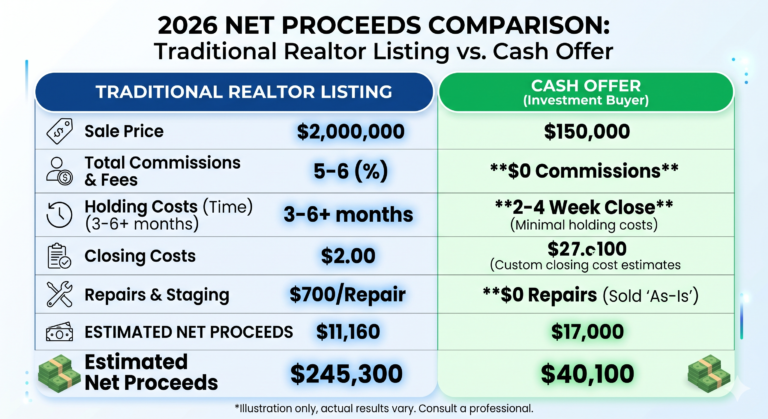
Understanding the Investor Mindset: Why They Offer Less and How to Pivot
Understanding the Investor Mindset: Why They Offer Less and How to Pivot
Real estate investors operate on a different logic than retail buyers. While a family looks for a ‘forever home,’ an investor looks for a ‘yield-bearing asset.’ Most professional buyers utilize the 70% Rule: they aim to pay no more than 70% of the property’s After Repair Value (ARV) minus the cost of necessary renovations. To effectively negotiate with investors, you must understand their mathematical framework and present data that justifies a deviation from their standard discount.
The Technical Math Behind Investor Offers
Investors calculate their Maximum Allowable Offer (MAO) using this formula:
- ARV (After Repair Value): What the house is worth fully renovated.
- Repair Costs: Estimated budget for materials and labor.
- Holding Costs: Taxes, insurance, and interest paid during the flip.
- Desired Profit: Typically 15-20% of the ARV.
By identifying errors in their repair estimates or providing more accurate ‘comps’ (comparable sales), you can successfully engage in counter-offering cash buyers to secure a higher closing price.
Featured Snippet: How to Negotiate with Real Estate Investors
To negotiate a higher price with a real estate investor, you must leverage three main pillars: professional documentation, competitive tension, and transactional speed. Start by obtaining an independent pre-inspection report to challenge high repair estimates. Next, present ‘as-is’ market data from the last 90 days to establish a firm floor price. Finally, signal that you are talking to multiple investment firms (i.e., ‘iBuyers’ and local flippers) to trigger their competitive instincts, as investors are often willing to reduce their profit margin to 10-12% to beat out a competitor for a high-potential property.
Top 5 Real Estate Negotiation Tips for Sellers
1. Get a Professional Pre-Inspection
Investors often use ‘unforeseen repairs’ as a leverage point to lower their offer during the due diligence period. By having an independent inspection report ready, you remove their ability to inflate repair costs. If they claim the roof needs $15,000 in work, and your report says $8,000, you have immediate leverage to demand $7,000 more.
2. Highlight the ‘Turnkey’ Potential
If your property is a ‘rental-ready’ asset rather than a ‘fixer-upper,’ emphasize the immediate Cash-on-Cash return. Investors are often willing to pay a premium for properties that require zero downtime before a tenant moves in.
3. Create a Bidding War
Never accept the first offer. Reach out to at least three different types of investors: a local ‘We Buy Houses’ group, a national iBuyer (like Opendoor or Offerpad), and a local landlord. Use the highest offer as a benchmark to counter-offer the others.
4. Leverage the ‘Speed Premium’
Cash buyers value speed and certainty. If you are flexible on the closing date but firm on the price, you can often bridge the gap. Tell the investor: ‘I can close in 7 days if you meet my price, otherwise, I will list on the MLS for a higher amount and wait 60 days.’
5. Know Your ‘Walk-Away’ Number
Statistics from the National Association of Realtors (NAR) suggest that cash sales typically close for 10-15% less than traditional sales due to the convenience factor. Determine if that 15% discount is worth the saved commissions (6%) and closing costs. If their offer exceeds a 20% discount, you have significant room to counter.
Investor vs. Traditional Market Comparison
| Feature | Real Estate Investor (Cash) | Traditional Retail Buyer |
|---|---|---|
| Closing Speed | 7 – 14 Days | 30 – 60 Days |
| Repairs Needed | None (As-Is) | Often requires inspection fixes |
| Average Price | 80% – 90% of FMV | 95% – 100% of FMV |
| Fees/Commissions | 0% | 5% – 6% |
| Probability of Closing | Very High (No Financing Contingency) | Moderate (Subject to Mortgage Approval) |
Checklist: Preparing for the Counter-Offer
- [ ] **Verify Proof of Funds:** Ensure the investor actually has the cash to close.
- [ ] **Review the ‘Comps’:** Pull local sales data from the last 3-6 months.
- [ ] **Itemize Recent Upgrades:** Even small updates (new HVAC, water heater) increase the base value.
- [ ] **Set a Deadline:** Give the investor 24-48 hours to respond to your counter to maintain momentum.
Frequently Asked Questions
Can I really negotiate with a ‘We Buy Houses’ company?
Yes. These companies expect a negotiation. Their first offer is almost always their ‘floor’ offer. By presenting market data and showing you have other options, they will often increase their price by 5-10% to secure the deal.
What is the most effective way to counter-offer a cash buyer?
The most effective method is the ‘Split the Difference’ approach backed by data. If their offer is $200k and your goal is $230k, present evidence why the home is worth $240k and suggest meeting at $220k for an immediate signature.
Do investors pay more for certain locations?
Absolutely. Investors focus on ‘Opportunity Zones’ or areas with high rental demand. If your property is in a high-growth ZIP code, emphasize the appreciation potential, which may allow the investor to accept a lower immediate ROI.