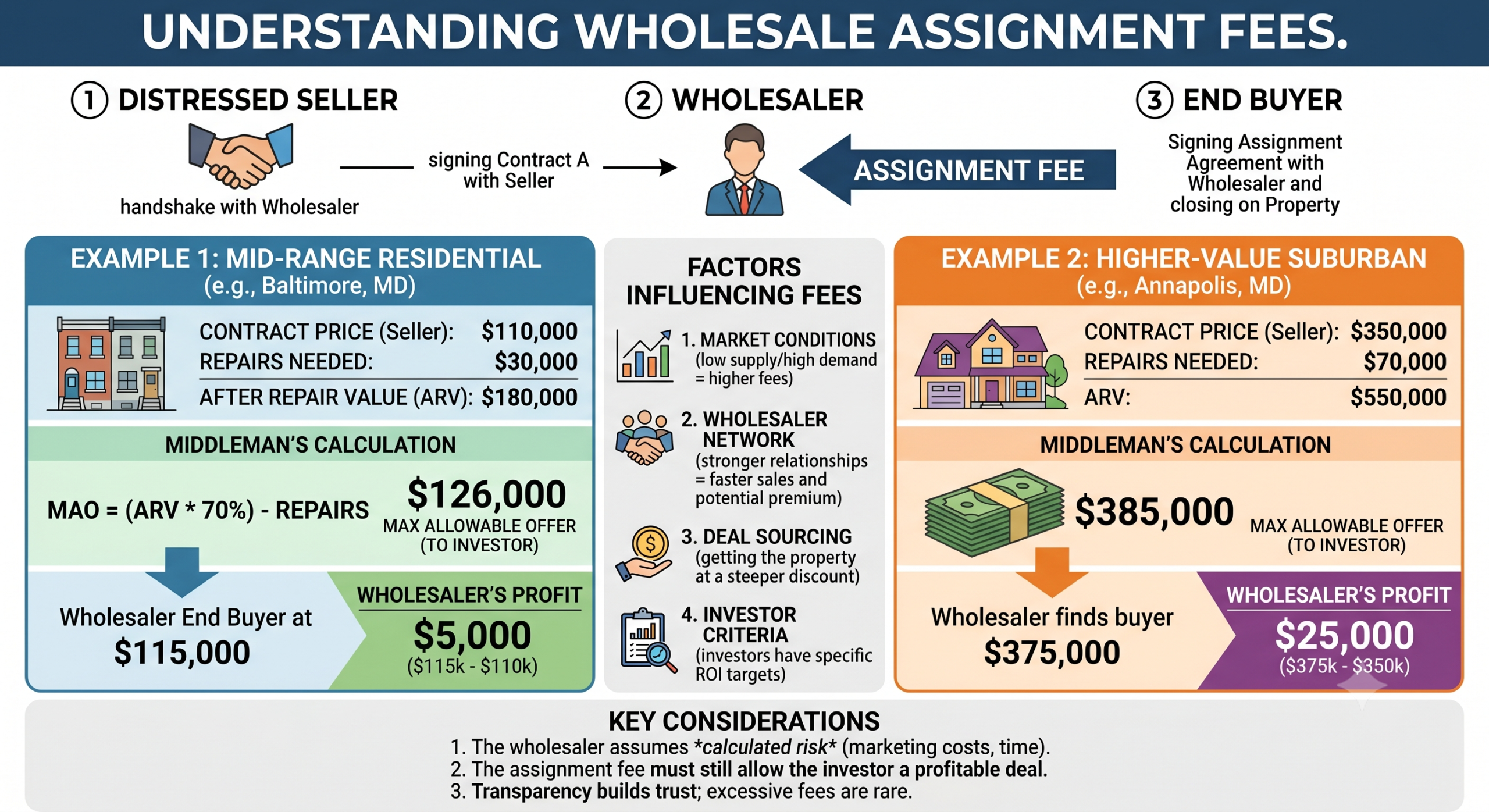
Wholesale Assignment Fees: How Much is the Middleman Making?
Featured Snippet: What is a Wholesale Assignment Fee?
A wholesale assignment fee is the profit a real estate wholesaler earns for finding a distressed property, securing it under contract, and then ‘assigning’ that contract to a cash buyer. On average, wholesale assignment fees range between $5,000 and $10,000 per deal. However, in high-equity markets or on complex commercial deals, these fees can exceed $50,000. This fee is technically the difference between the purchase price agreed upon with the seller and the final price paid by the end-investor.
Understanding the Real Estate Middleman Profit Model
In the world of real estate investing, the wholesaler acts as the ultimate ‘middleman.’ Their primary value proposition is the ability to source off-market properties at a significant discount. The real estate middleman profit is not a commission in the traditional sense; it is a contractual right to purchase that is sold to another party. This process allows investors to participate in real estate transactions without the need for significant capital, credit, or the burdens of property management.
How Much Do Wholesalers Actually Make? (2024-2025 Data)
Data from nationwide real estate investment platforms and market consensus indicates that while the ‘median’ fee remains stable, the ceiling for wholesale assignment fees has risen due to increased competition and sophisticated marketing. Below is a breakdown of typical profit margins based on deal volume and property type.
| Deal Tier | Property Value Range | Average Assignment Fee | Profit Percentage (of ARV) |
|---|---|---|---|
| Micro-Wholesale | $50k – $150k | $2,000 – $5,000 | 2% – 4% |
| Standard Residential | $150k – $400k | $5,000 – $15,000 | 3% – 7% |
| High-Equity / Luxury | $400k – $800k+ | $20,000 – $50,000+ | 5% – 10% |
| Commercial Wholesale | $1M+ | $50,000+ | Variable |
Factors Influencing the Assignment Fee
- Property Equity: The more ‘meat on the bone’ (equity), the higher the potential fee. If a wholesaler secures a property at 50% of its After Repair Value (ARV), they have more room to charge a premium.
- Market Demand: In ‘hot’ markets like Phoenix, Tampa, or Austin, cash buyers are often willing to pay higher fees to secure a viable deal.
- Relationship with Buyers: Established wholesalers with a vetted list of reliable cash buyers can often command higher fees because their buyers trust their math and due diligence.
The Math Behind the Middleman: The MAO Formula
To ensure assignment contract transparent prices, professional wholesalers use the Maximum Allowable Offer (MAO) formula. This ensures the end-buyer still has enough margin to make a profit after repairs and holding costs.
MAO = (ARV × 70%) – Estimated Repair Costs – Desired Assignment Fee
For example, if a house has an ARV of $300,000 and needs $40,000 in repairs, the calculation would look like this:
($300,000 × 0.70) = $210,000
$210,000 – $40,000 = $170,000.
If the wholesaler wants a $10,000 fee, they must get the property under contract with the seller for $160,000.
Transparency and Ethics in Assignment Fees
One of the most contentious aspects of wholesaling is the disclosure of the assignment fee. In a standard assignment, the end-buyer sees exactly how much the wholesaler is making on the settlement statement (HUD-1). To maintain professional standards, wholesalers should focus on:
- Full Disclosure: Being upfront with the end-buyer about the fee amount to avoid last-minute friction at the closing table.
- Value Addition: Providing detailed inspection reports, photos, and accurate repair estimates to justify the fee.
- Legal Compliance: Ensuring they are not practicing ‘brokerage without a license’ by strictly marketing the *contract* and not the *property* itself.
Wholesale Fee vs. Real Estate Commission
It is important to distinguish between a wholesaler’s fee and a Realtor’s commission. A Realtor represents a client and has a fiduciary duty, typically earning 2.5% to 3% of the sale price. A wholesaler is a principal in the transaction (the buyer) who is selling their equitable interest.
| Feature | Wholesale Assignment Fee | Real Estate Commission |
|---|---|---|
| Regulation | Contract Law (Varies by State) | Real Estate Licensing Board |
| Fiduciary Duty | No (Principal to Principal) | Yes (Agent to Client) |
| Typical Amount | Flat Fee ($5k – $15k) | Percentage (5% – 6% total) |
| Transparency | Visible on Settlement Statement | Visible on Closing Disclosure |
Frequently Asked Questions
Is there a legal limit on how much a wholesaler can make?
Technically, no. There is no federal or state law that caps the amount of profit a wholesaler can make on a contract assignment. It is entirely determined by the spread between the purchase price and what a buyer is willing to pay. However, some states (like Illinois) require a license if you engage in a certain number of wholesale deals per year.
Do wholesalers pay taxes on assignment fees?
Yes. Assignment fees are considered ordinary income by the IRS. Since wholesalers are technically providing a service/flipping a contract rather than holding an asset, these profits are subject to self-employment tax and standard income tax rates.
Can a seller refuse to pay the assignment fee?
The seller does not ‘pay’ the fee; the end-buyer does. The seller receives exactly what they agreed to in their original contract. However, if the seller is unhappy seeing a large assignment fee at closing, it can sometimes cause emotional friction, which is why some wholesalers prefer ‘double closing’ on larger spreads.
What is a ‘Double Closing’ and how does it hide the fee?
In a double closing, the wholesaler buys the property from the seller and immediately sells it to the end-buyer in two separate transactions. This requires ‘transitional funding’ and incurs two sets of closing costs, but it keeps the wholesaler’s profit private from both the original seller and the end-buyer.