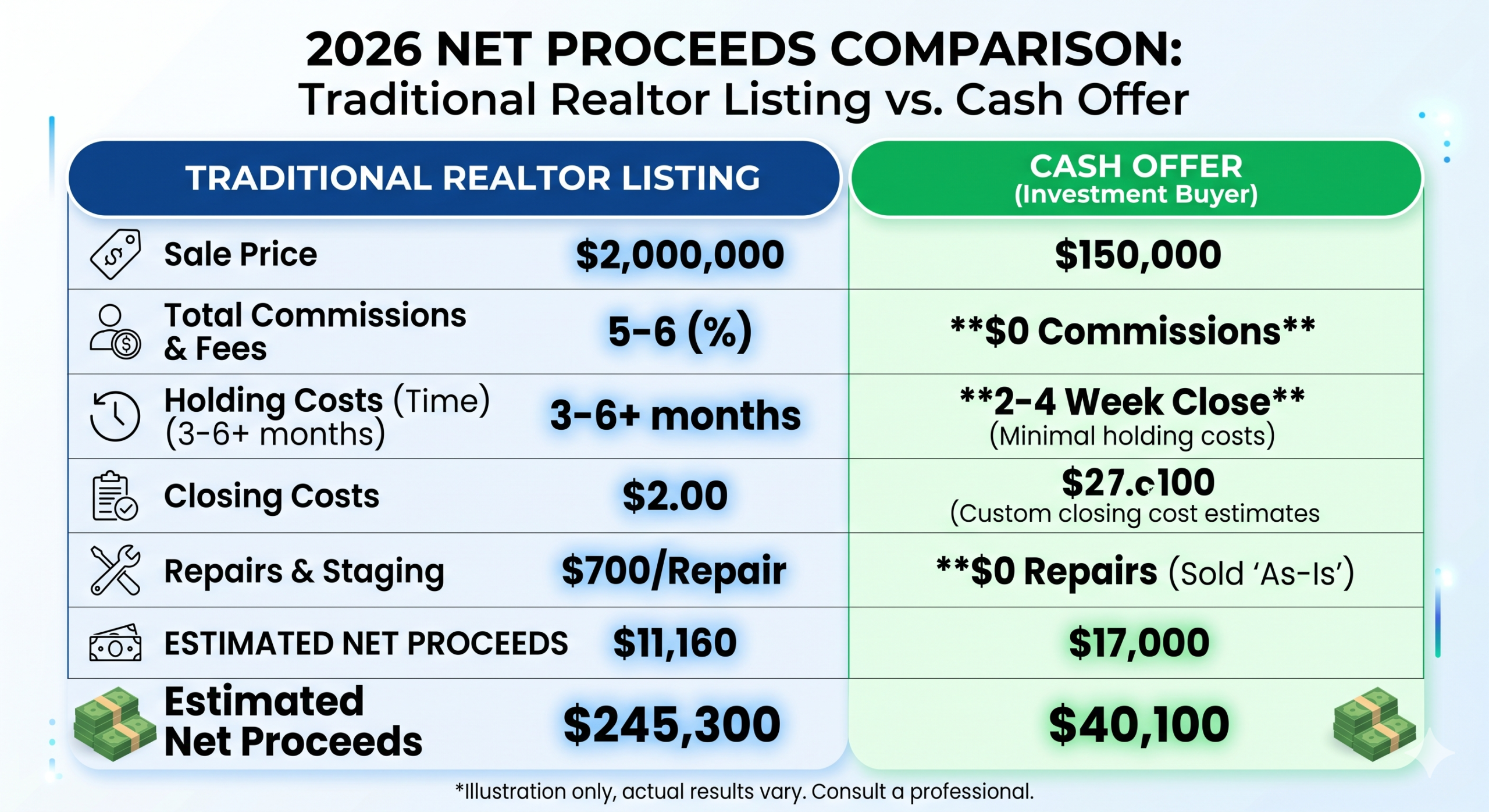
Cash Offer vs. Realtor Listing: 2026 Net Proceeds Comparison
In the 2026 real estate landscape, sellers face a critical crossroads: the traditional route of a Realtor listing or the streamlined path of a direct cash offer. While a Realtor listing often yields a higher gross sale price, the net proceeds—the actual cash that reaches your bank account—can tell a different story. This guide breaks down the financial mechanics of both methods to help you maximize your home equity.
Featured Snippet: Cash Offer vs. Realtor Listing Net Proceeds
When comparing a cash offer vs. a Realtor listing, the ‘net proceeds’ are determined by subtracting commissions (5-6%), closing costs (1-3%), repair expenses (2-5%), and holding costs from the gross sale price. While Realtors may secure a price 15-20% higher than cash buyers, the absence of fees and repairs in a cash sale often closes the gap to within 5-8% in total net value, while saving an average of 65 days in transaction time.
The Financial Breakdown: Realtor Listing Costs
Selling via a Realtor involves a variety of ‘leakage’ points where your equity is eroded by service fees and market requirements. In 2026, with interest rates stabilizing, buyer expectations for ‘turn-key’ properties remain at an all-time high.
1. Commission and Service Fees
Despite various legal shifts in commission structures, the standard remains approximately 5% to 6% of the sale price, split between the listing agent and the buyer’s agent. On a $400,000 home, this immediately removes $24,000 from your net proceeds.
2. Preparation and Repair Costs
To compete on the open market, most homes require staging, professional cleaning, and deferred maintenance repairs. Industry data suggests sellers spend an average of 2% to 4% of the home value on pre-listing improvements to satisfy 2026 buyer standards.
3. Holding Costs
The ‘cost of time’ is often overlooked. Every month a house sits on the market, the seller incurs mortgage payments, property taxes, insurance, and utility costs. With the average 2026 ‘Days on Market’ (DOM) hovering around 45-60 days, these costs can add up to thousands.
The Cash Offer Advantage: Speed and Certainty
A cash offer comparison focuses on efficiency. Cash buyers, often institutional investors or local ‘fix-and-flip’ experts, purchase properties ‘as-is,’ meaning the seller avoids the traditional hurdles of inspections, appraisals, and bank financing approvals.
- Zero Commissions: You deal directly with the buyer, bypassing the 6% agent fee.
- No Repair Credits: You sell the house in its current condition, regardless of roof age or HVAC status.
- Closed in Days: Most cash transactions close within 7 to 14 days, eliminating months of holding costs.
Side-by-Side Comparison: Net Proceeds Case Study
Consider a property with an After Repair Value (ARV) of $400,000 that requires $20,000 in updates.
| Expense Category | Traditional Realtor Listing | Direct Cash Offer |
|---|---|---|
| Gross Sale Price | $400,000 | $335,000 (83% of ARV) |
| Agent Commissions (6%) | -$24,000 | $0 |
| Seller Paid Closing Costs (2%) | -$8,000 | $0 (Buyer Pays) |
| Repairs & Staging | -$20,000 | $0 |
| Holding Costs (3 Months) | -$7,500 | -$500 (1 Week) |
| Total Net Proceeds | $340,500 | $334,500 |
Analyzing the Result
In this scenario, the traditional listing yielded only $6,000 more than the cash offer. However, the cash offer was completed in 10 days versus 90 days. For many sellers, the $6,000 premium is not worth the stress of 20+ showings, inspection negotiations, and the risk of a buyer’s financing falling through.
Is a Cash Offer Right for You?
Choosing to sell a house for cash vs. a Realtor depends on your specific priorities. A Realtor listing is ideal if your home is in pristine condition and you have the luxury of time. A cash offer is superior if you are facing foreclosure, dealing with an inherited property, or need to relocate quickly for a job.
Checklist: When to Choose a Cash Buyer
- The property requires significant structural or cosmetic repairs.
- You need to access your equity in under 21 days.
- You want to avoid the ‘parade of strangers’ through your home.
- You have a high-interest mortgage and want to stop the ‘burn rate’ of monthly payments.
Frequently Asked Questions
Do cash buyers always offer 70% of market value?
No. While the ‘70% rule’ was a historical benchmark, 2026 market competition among institutional buyers has pushed offers closer to 80-85% of the After Repair Value, depending on the local market inventory levels.
Will I have to pay any fees with a cash offer?
Typically, reputable cash buyers cover all closing costs, including title insurance and escrow fees. You should always review the settlement statement to ensure no hidden ‘service fees’ are deducted.
How does the 2026 interest rate environment affect my choice?
Higher interest rates make traditional buyers more cautious and increase the likelihood of financing contingencies failing. Cash offers are immune to mortgage rate fluctuations, providing a ‘sure thing’ in a volatile market.