iBuyer vs. Traditional Sale Calculator: Comparing Total Fees and Net Proceeds
iBuyer vs. Traditional Sale Calculator: Comparing Total Fees and Net Proceeds
Featured Snippet: How do iBuyer fees compare to traditional commissions?
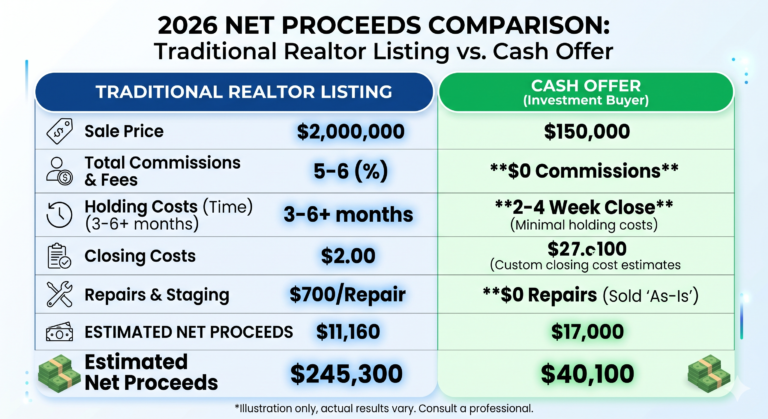
An iBuyer vs. traditional sale calculator reveals that while a traditional sale typically involves a 5-6% realtor commission, iBuyers like Opendoor and Offerpad charge a service fee (averaging 5%) plus repair deductions and a selling convenience fee. Total iBuyer costs generally range from 7% to 12% of the home’s value, whereas a traditional sale ranges from 6% to 10%, including closing costs and concessions. The primary trade-off is speed and certainty versus maximum net profit.
Deciding between a quick cash offer from an iBuyer and a traditional market listing is no longer just about the sale price. In today’s market, the “net proceeds”—the amount of cash you actually pocket—is dictated by a complex web of service charges, repair credits, and holding costs. This guide breaks down the math behind an iBuyer vs traditional sale calculator to help you determine if the convenience is worth the cost.
The Core Comparison: iBuyer Fees vs. Traditional Sale Costs
To compare these two paths accurately, we must look beyond the Opendoor fees vs realtor commission debate. While the commission is the largest line item in a traditional sale, iBuyers use a different terminology, often incorporating a “selling convenience fee” or service charge that covers their cost of capital and resale risk.
1. Service Fees & Commissions
- Traditional Sale: Historically, sellers paid 5-6% in total commissions (split between buyer and seller agents). Following the 2024 NAR settlement, these structures are more negotiable, but sellers often still budget 4-6% to remain competitive.
- iBuyer (Opendoor/Offerpad): These companies typically charge a flat service fee of 5%. This replaces the listing agent commission but is applied to an offer that may already be 1-3% below fair market value.
2. Repair Deductions
In a traditional sale, you choose which repairs to make or negotiate a credit with the buyer. iBuyers conduct their own assessment and deduct a repair credit directly from your proceeds. These deductions are often non-negotiable and can be higher than DIY repair costs because the iBuyer uses licensed contractors for all work.
Performance Metric Table: iBuyer vs. Traditional Sale
This table compares the estimated costs for a home valued at $400,000 to show the impact on net proceeds.
| Fee Category | iBuyer (Opendoor/Offerpad) | Traditional Sale (Realtor) |
|---|---|---|
| Offer/Sale Price | $392,000 (Market -2%) | $400,000 (Fair Market Value) |
| Service Fee / Commission | $19,600 (5% Fee) | $22,000 (5.5% Avg.) |
| Closing Costs (Seller) | $4,000 (1%) | $6,000 (1.5%) |
| Repair Costs / Credits | $8,000 (Deducted) | $4,000 (Negotiated) |
| Holding Costs (2-3 Months) | $0 (Fast Close) | $5,500 (Mortgage/Tax/Ins) |
| Estimated Net Proceeds | $360,400 | $362,500 |
The “Selling Convenience Fee” Explained
The selling convenience fee is the intangible cost of avoiding the stress of the open market. When using an iBuyer, you are paying for the ability to skip:
- Showings & Open Houses: No need to keep your home “stage-ready” for weeks.
- Financing Contingencies: iBuyers provide cash offers, eliminating the 15% risk of a deal falling through due to buyer loan denial.
- Flexible Timelines: You can choose a closing date between 14 and 60 days, allowing for a seamless transition to your next home.
Checklist: Which Selling Method is Right for You?
Before using an iBuyer vs traditional sale calculator, ask yourself these critical questions:
- Do I need to move in under 30 days? If yes, the iBuyer path is likely worth the fee premium.
- Is my home in “perfect” condition? iBuyers prefer newer homes (post-1950) with standard layouts; unique or distressed properties may receive significantly lower offers.
- Am I sensitive to market volatility? In a cooling market, a guaranteed cash offer today may be safer than a potential 90-day wait on the MLS.
- Can I afford a 2-5% hit to my equity? If your mortgage balance is high, the extra fees of an iBuyer might make it impossible to cover your payoff.
Frequently Asked Questions
Does Opendoor pay closing costs?
No. While Opendoor simplifies the process, the seller is still responsible for traditional seller-side closing costs, such as title insurance, transfer taxes, and escrow fees. These are typically 1-2% of the sale price.
Why is the iBuyer repair deduction so high?
iBuyers aim to resell the home quickly. Their inspection identifies every potential issue that a future buyer’s inspector might find. They deduct the cost of professional repairs so they can perform the work immediately after you move out, ensuring the home is “move-in ready” for the next owner.
Can I negotiate the service fee with an iBuyer?
Generally, no. iBuyer service fees (like Opendoor’s 5%) are fixed within their algorithm. However, you can sometimes negotiate the repair credit if you can prove a specific item (like a roof or HVAC) was recently replaced and is under warranty.
What is the biggest hidden cost of a traditional sale?
Holding costs are the most overlooked expense. Every month your home sits on the market, you pay the mortgage, property taxes, HOA fees, and utilities. A traditional sale taking 3-4 months can easily cost an additional $6,000 to $10,000 in carrying costs that iBuyer sellers avoid.
Conclusion: Calculating Your Best Move
An iBuyer vs traditional sale calculator demonstrates that the “best” option is subjective. If your goal is to extract every cent of equity and you have the time to wait for the right buyer, the traditional realtor commission model remains superior. However, if you are relocating for a job or buying another home simultaneously, the selling convenience fee offered by iBuyers provides a level of certainty that many find invaluable in a shifting real estate landscape.